Retail-First Influencer Campaigns
March 25, 2026
Unlike DTC campaigns, retail activations require a sharper focus on intent.
Driving awareness is one thing... but driving someone to actually walk into a store and buy? That’s where influencer marketing gets interesting.
Retail partnerships introduce a different layer of complexity. You’re not just competing for attention on a screen, but also action in a physical environment, often without direct attribution.
So how do we bridge that gap?
What’s different about retail-first influencer campaigns?
Unlike DTC campaigns, retail activations require a sharper focus on intent.
You’re not just asking: “Do people like this?”
You’re asking: “Will someone add this to their next Costco or Target run?”
That shift impacts:
- The creators we work with
- The content structure
- And the CTAs

Our Approach:
We’ve developed a repeatable framework for driving in-store sales through influencer:
1. Native, lifestyle-first content
The best-performing retail content doesn’t feel like an ad. It feels like part of someone’s real routine. Grocery hauls, integrated routine videos and family moments consistently outperform.
2. Clear retail callouts
We make the “where to buy” unmistakable. Whether it’s “available at Target” or showing the product on a Costco endcap, clarity drives action.
3. Paid amplification (whitelisting)
We scale what works. Strong organic content becomes even more powerful when paired with paid media driving to store locators or retailer pages.
Case Study: Mezcla at Target + Costco
For our client, Mezcla, the goal was to drive awareness and convert that into in-store purchases across Target and Costco.
The Strategy:
- Focus on family-oriented and lifestyle creators
- Leverage grocery hauls and everyday snack moments
- Highlight the product in-store to build familiarity and trust
The Results:
- 6.4M total impressions
- $22 organic CPM
- 1.8k comments
- 639 shares
- Strong sentiment in the comments like: “Adding this to my next Target run” and “Need to try these next time I’m at Costco”


Why It Worked:
The content didn’t just show the product, it showed when and why you’d buy it.
That context is what turns passive viewers into active shoppers.


Case Study: OWYN at Costco + Sam’s Club
OWYN’s campaigns leaned heavily into scale and performance, while still maintaining authenticity.
Campaign Highlights:
- 20M total impressions
- $8 blended CPM
- 66 pieces of content across 21 creators
- 1.9k comments
- 2.4k shares
What Stood Out:
- Creators clearly called out new product availability in-store
- Content felt native across fitness, lifestyle, and family audiences
- Whitelisting top performers drove efficient traffic at scale
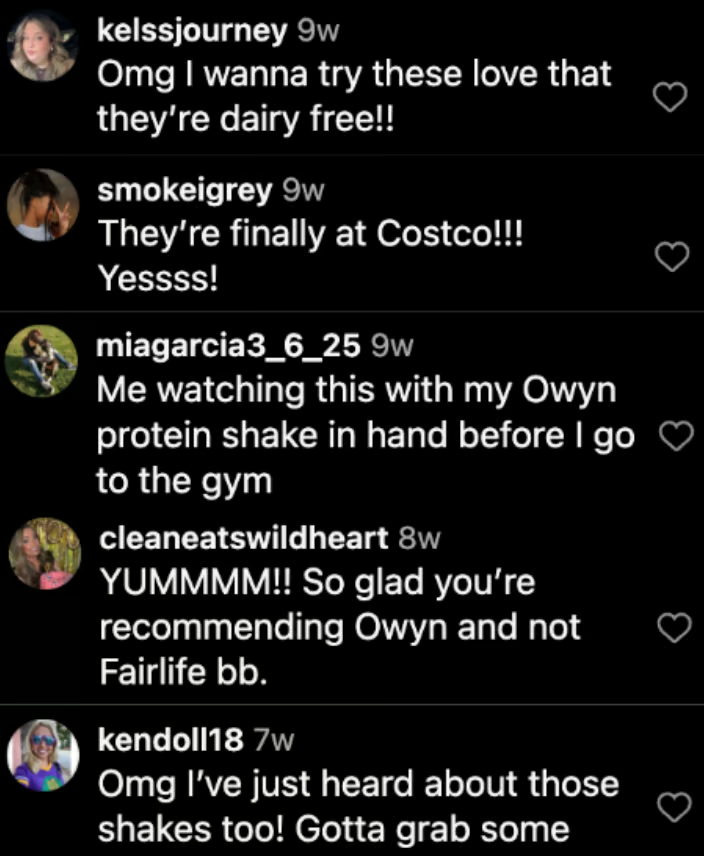
Most importantly, comment sections were filled with purchase intent, the signal we look for.
- “Didn’t know these were at Costco now”
- “Adding to my Sam’s Club list”


What Actually Drives Someone In-Store?
Across every campaign, the same patterns show up:
1. Familiarity builds confidence
Seeing a product in-store within content removes friction.
2. Context creates intent.
“Snack I grab during a Target run” > “You should try this”
3. Authenticity beats polish.
The more native the content feels, the more likely it is to convert.
4. Comments are a conversion signal.
Pay attention to sentiment and intent
- “Adding to my list”
- “Going to pick this up”
- “Saw this at Costco yesterday”
That’s real retail impact.
The Bottom Line…
Influencer marketing doesn’t stop at awareness. When you do it right, it becomes a powerful lever for retail growth driving real-world purchase behavior.